The metawork trap and AI’s role
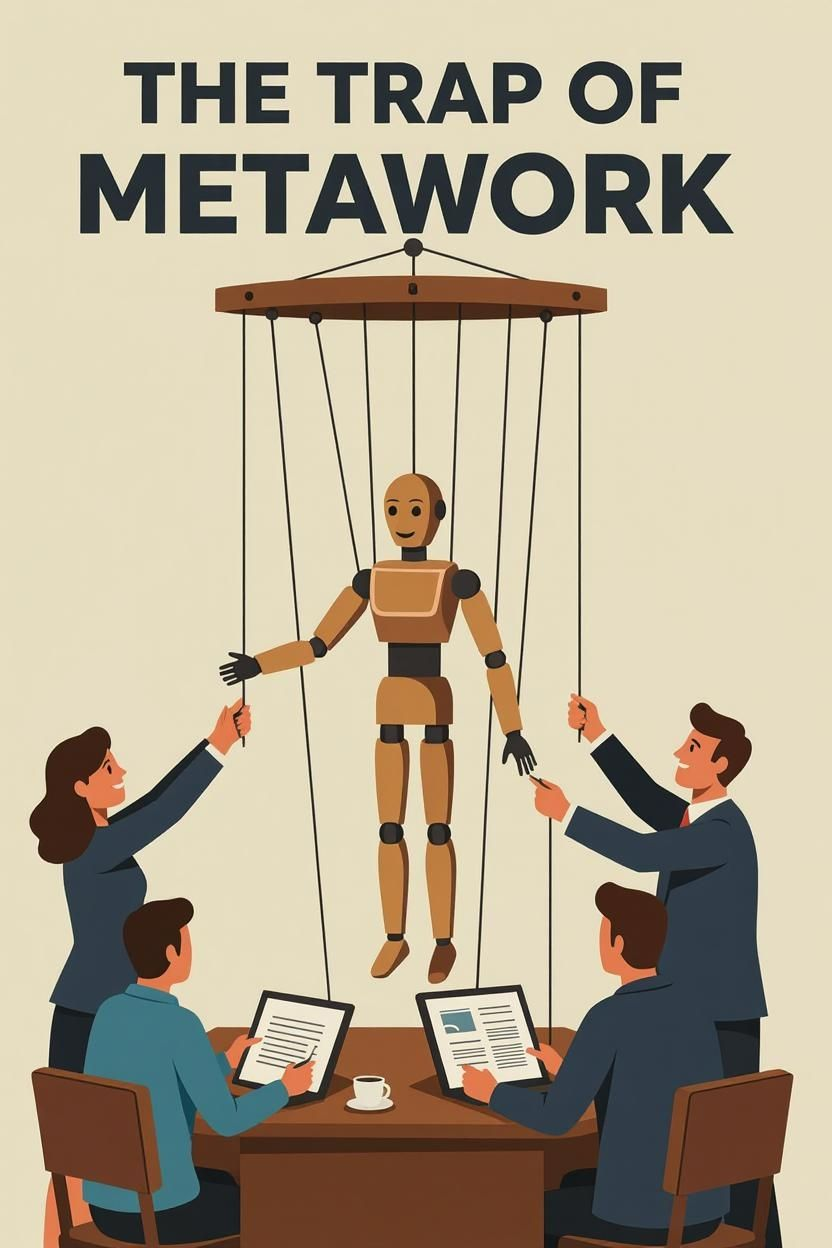
Here’s the irony: while Microsoft, Google, and OpenAI push AI as a cure-all, many workers are drowning in metawork, work about work. Knowledge workers spend up to 60% of their time on administrative tasks: managing tools, navigating clunky interfaces, or wrangling processes that didn’t exist a decade ago.
In an architecture and construction project, teams juggle design software, project management platforms, and stakeholder communications, each with its own learning curve. These tools, meant to empower, often pile up, fragmenting focus and eating time. Their capabilities are vast, but most teams barely scratch the surface.
When automation multiplies the mess
Consider a real-world pattern where AI’s automation, intended as a time-saver, exacerbates the metawork trap. Auto-generating slide decks or emails might seem efficient at first glance. You input a few prompts, and out comes a polished presentation or message.
But what happens on the receiving end? The email arrives, only to be summarized by another AI on the recipient’s side, with actions inferred automatically. This sets off a chain: the inferred actions trigger responses, perhaps another AI-generated reply, leading to back-and-forth exchanges that devolve into a complete mess.
Without real human oversight to grasp the big picture, nuances get lost, misunderstandings proliferate, and productivity suffers. After all, emails were designed for direct human communication, not for AIs to battle over interpretations in an endless loop.
Errors that cascade
Similarly, in project updates or reports, AI might churn out summaries or visuals, but if teams on both sides rely on automated tools without verification, errors compound. An incorrect assumption in one report cascades into flawed decisions downstream, turning what should be streamlined collaboration into a tangle of corrections and clarifications.
This highlights how unchecked AI output can amplify metawork rather than reduce it. You do not save time if you spend it reconciling what the tools invented about each other.
“Efficiency is doing things right; effectiveness is doing the right things.” (Peter Drucker)
Clear the noise, don’t automate the loop
This is where AI can shine, not by replacing humans but by clearing the noise. AI, retasked with these insights, won’t automate the mundane but will eliminate them entirely. By offloading metawork, it frees architects to refine their vision, engineers to tackle novel structural challenges, and planners to engage with communities.
It’s a cycle of empowerment: reducing friction, while letting people focus on high-stakes innovation. The measure of success is not how many AI-generated artifacts fly between inboxes. It is whether humans get more of their day back for the work only they can do, judgment, craft, and relationships that make projects succeed.
Memion is built to cut work-about-work by capturing knowledge through natural conversation and putting it to use in daily plans and team context, so expertise is not buried under another layer of tools. See how it works.